Metanova
Metanova runs AI drug discovery as an on-chain competition. I designed the brand and the NOVA dashboard that turn it into one product both scientists and token holders can trust.
The brief: a product only experts could read
Metanova runs drug discovery as a decentralized competition: AI models score candidate molecules and nanobodies against protein targets, and the best submissions win on-chain. Half the audience reads chemistry but distrusts crypto; the other half follows the token but can't parse a binding score. There was no spec and no design system. My inputs were the raw API data and short notes from the team on how each number was computed.
The work: decisions, then screens
I worked through the raw data until I understood what each metric meant, then made the calls a spec would normally make: which metrics matter most, which can wait, and the clearest way to display each one. One rule shaped the product: never show a score without the reasoning that earns it. The four surfaces share one visual grammar, and the brand comes from the same system, so a 3D molecular viewer, an on-chain leaderboard and the mark on the landing page read as one credible product instead of a science project.
What this looks like on your team
This is the shape of my work for founders and product leads: drop into a domain I've never seen, find the decision logic under the data, and ship the interface and the brand as one system, inside real engineering constraints, without a spec to lean on. If your product asks people to trust numbers they can't interrogate, this is the problem I solve.
The surfaces
The three surfaces that carry the story.
The machinery of discovery, made legible
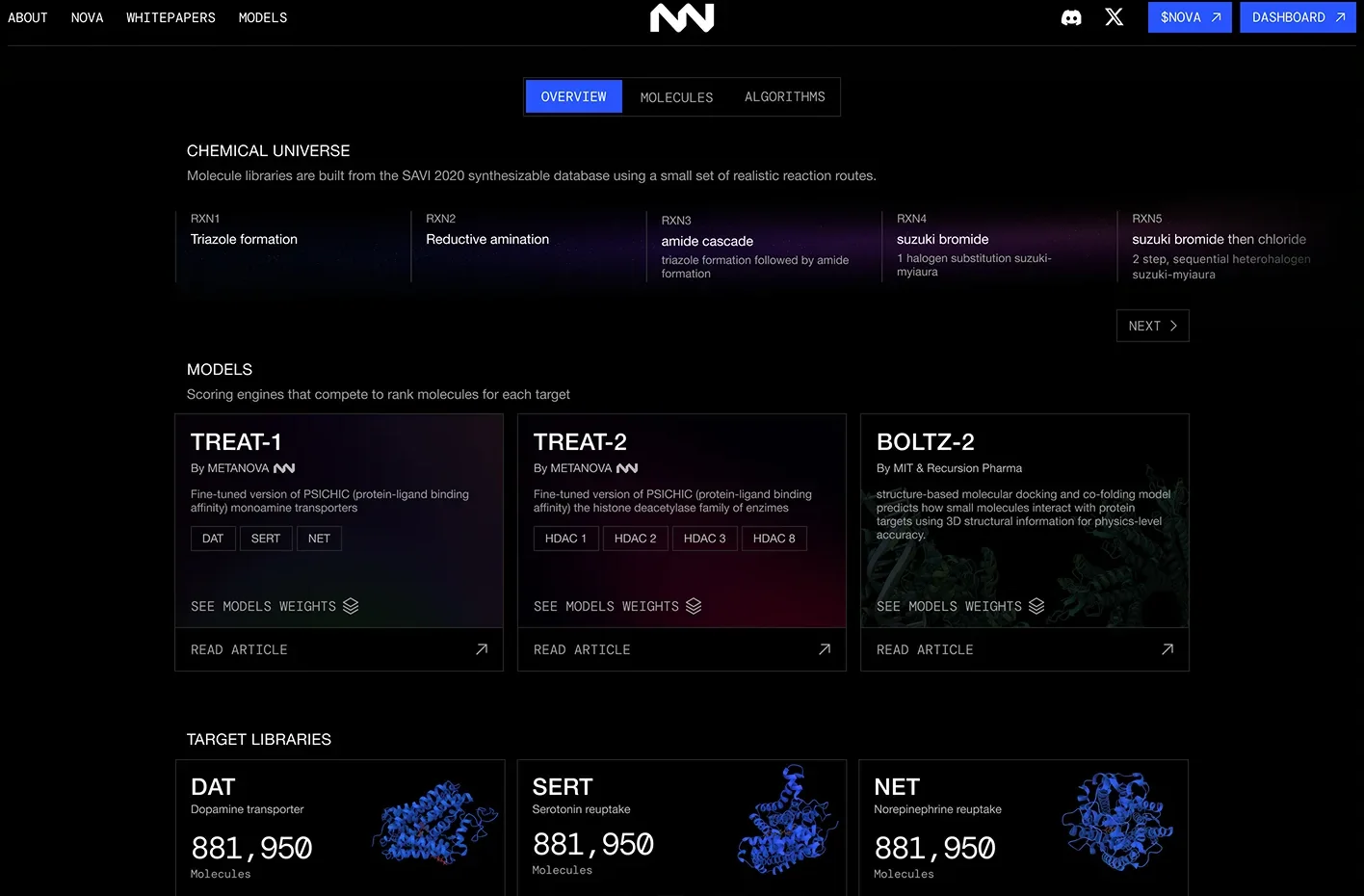
The Overview replaced a flat list of reactions, models and targets with a scannable narrative: how molecule libraries are built, which AI models compete to score them, and which protein targets are in play.
- The chemical universe reads as a small set of realistic reaction routes, not an opaque database dump.
- Competing scoring engines (TREAT-1, TREAT-2, BOLTZ-2) are framed as models racing to rank molecules per target.
- Target libraries (DAT, SERT, NET monoamine transporters) surface molecule counts, so scale is legible at a glance.
A competition you can read epoch by epoch
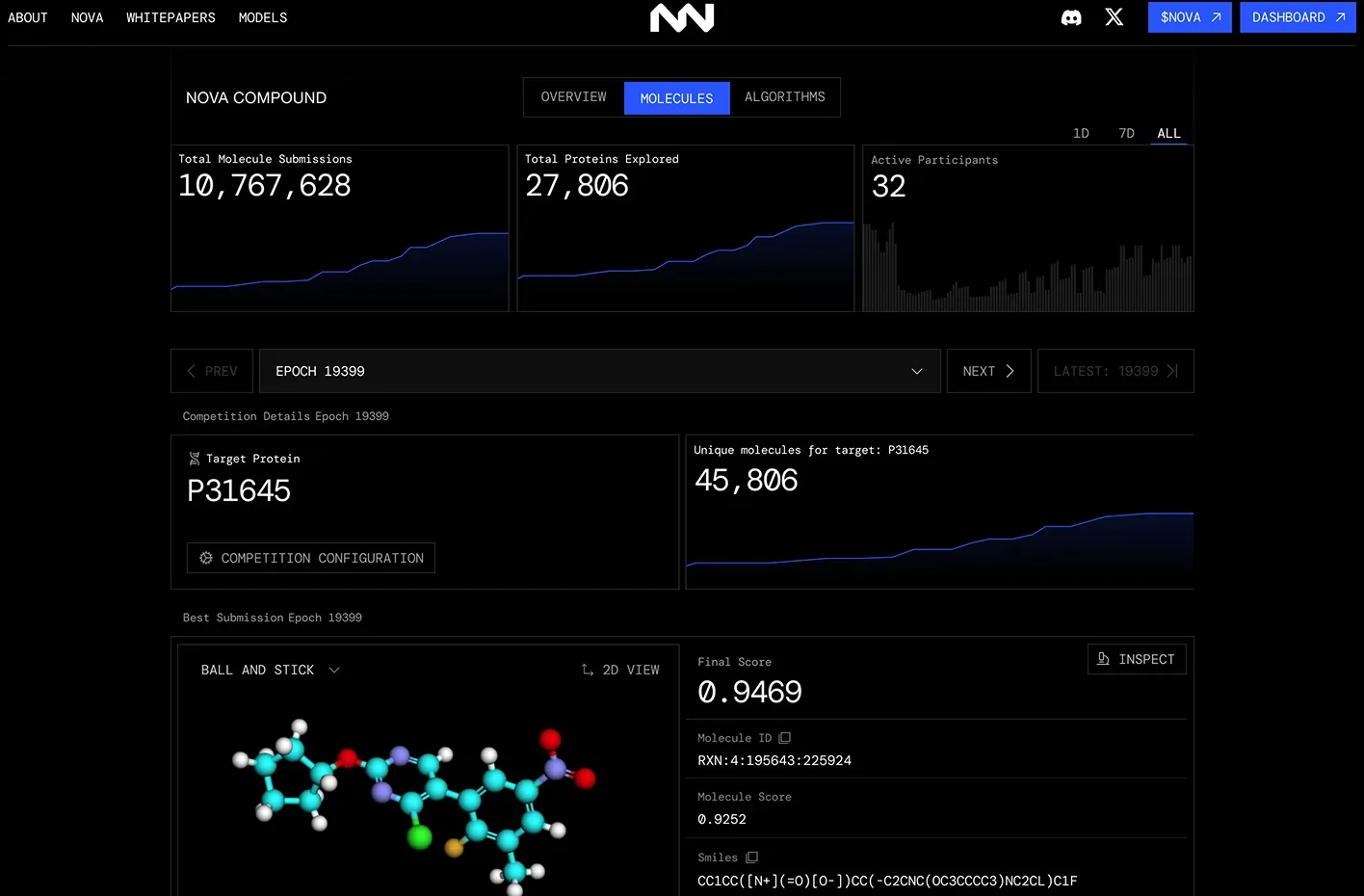
What used to be one dense scroll became a paced, epoch-by-epoch read: the winning molecule, why it won, and the field behind it each get their own moment.
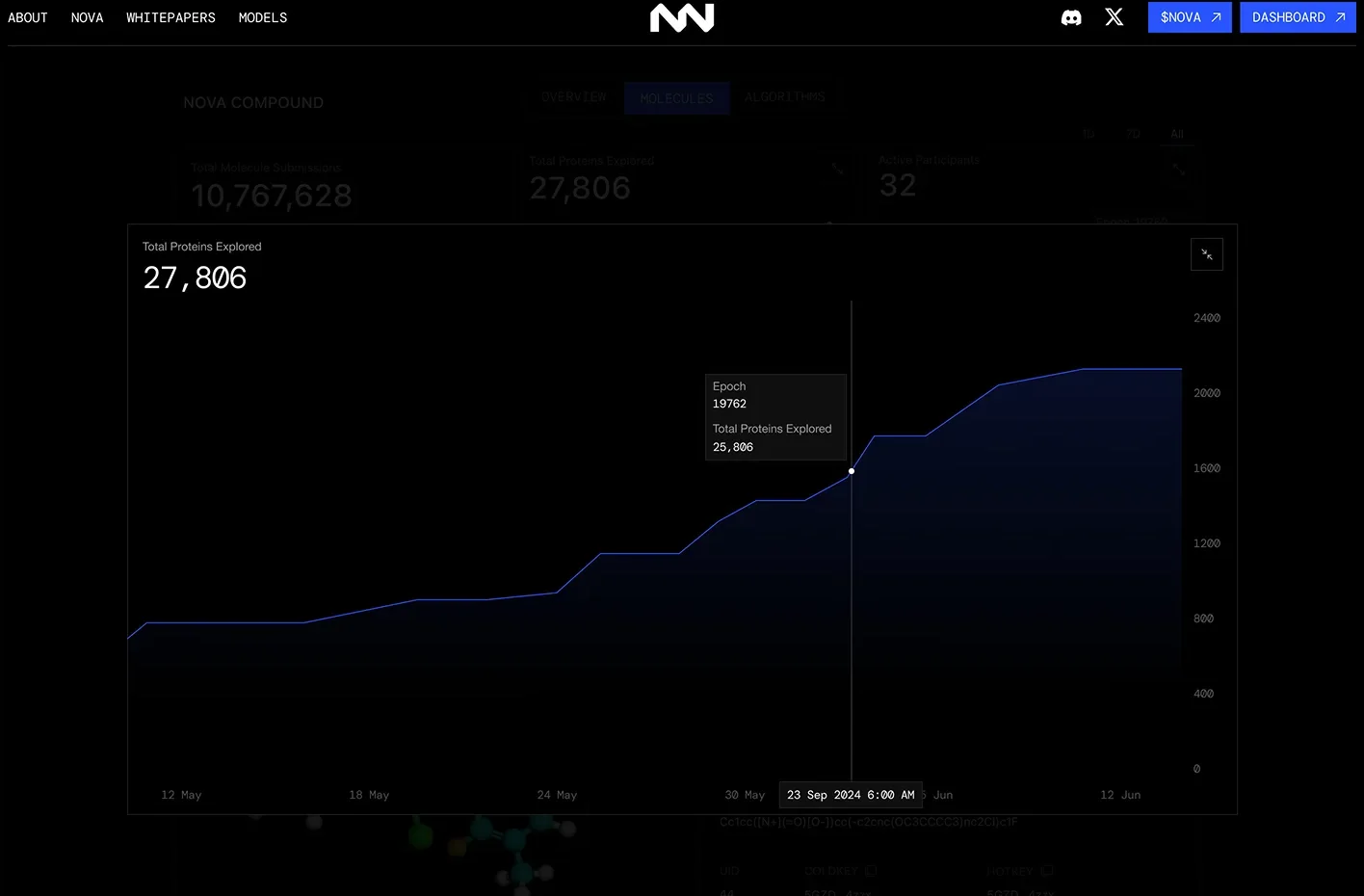
- Submissions, proteins explored and active participants anchor the scale of the competition up front.
- An epoch browser steps through the contest in time, per target protein, without losing context.
- Each epoch resolves to its best submission (3D molecule, final score, molecule ID, SMILES) beside the leaderboard.
Every win, explained by its metrics
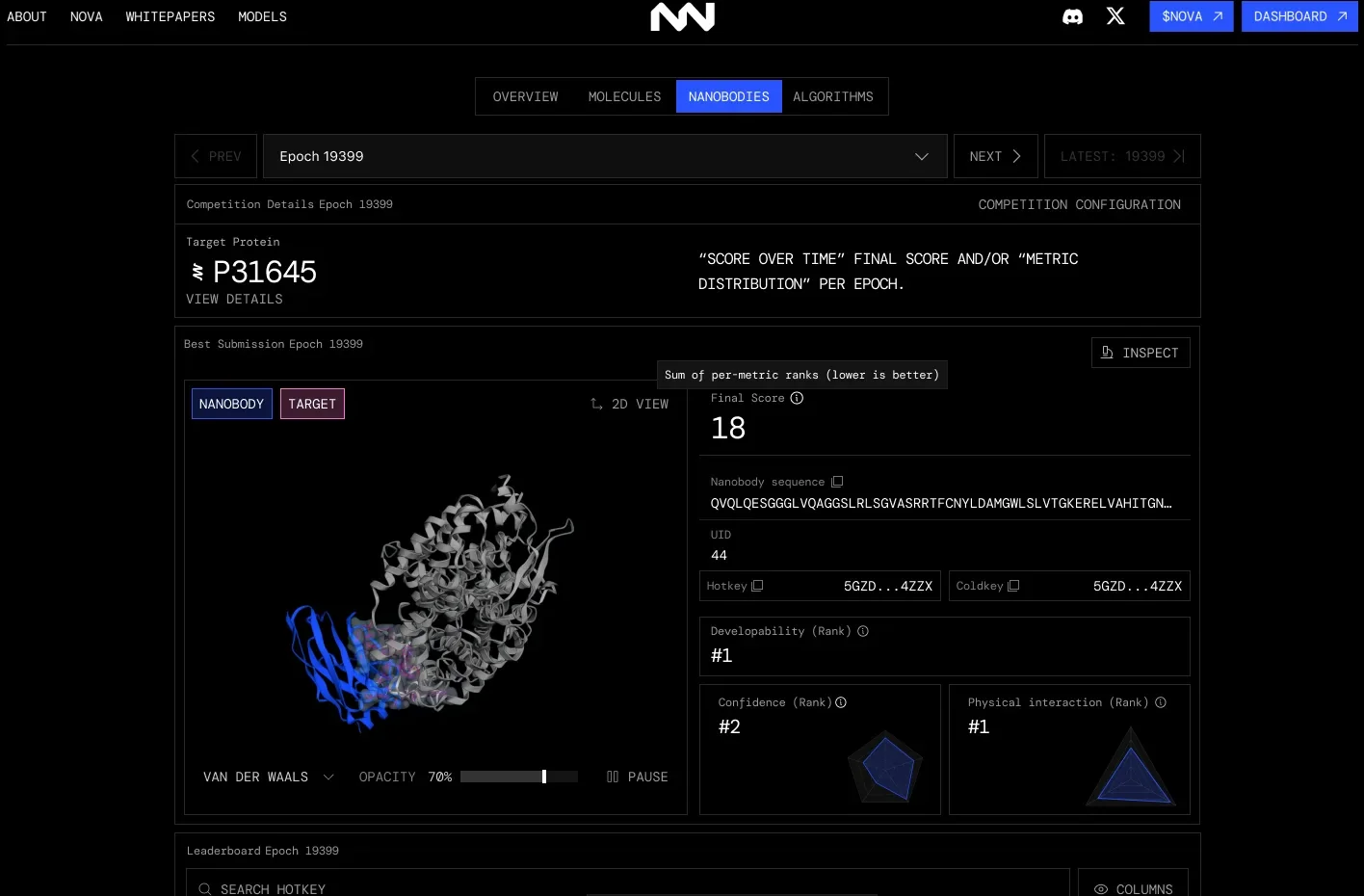
The Nanobodies surface answers not just which submission won, but why: the 3D nanobody-vs-target structure sits beside the metric breakdown that earns the score.
- A nanobody-vs-target viewer (Van der Waals, adjustable opacity) shows the binding, not just the number.
- The final score is the sum of per-metric ranks (developability, confidence, physical interaction), each shown as a ranked radar chart.
- Nanobody sequence and on-chain identity (UID, hotkey, coldkey) tie the science to its provenance.